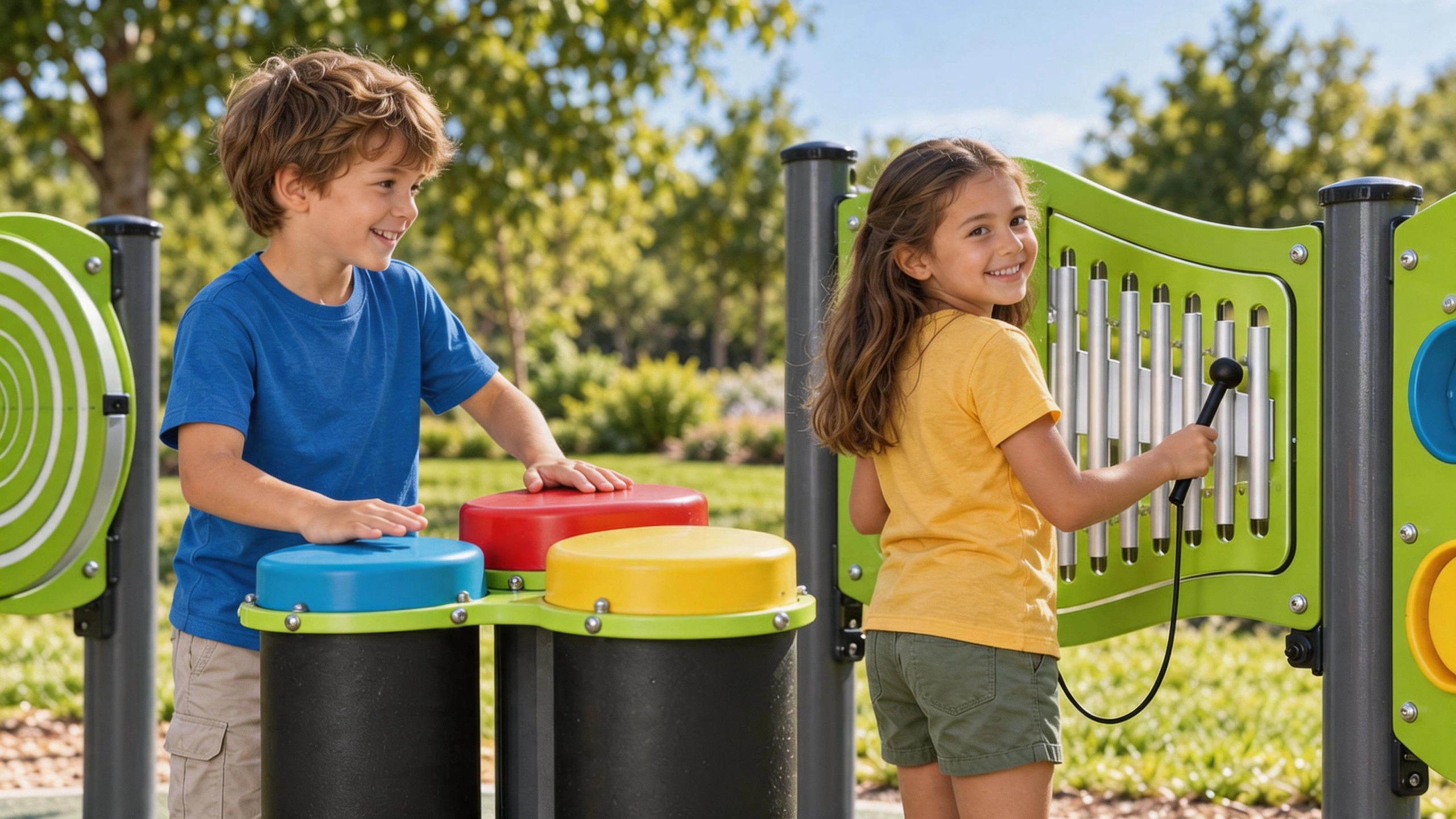
Quick Answer: Freestanding play structures are independent playground components such as swings, slides, climbers, spring riders, spinners, activity panels and musical instruments. They give commercial playground planners flexibility to add specific play experiences or expand an existing site. However, “freestanding” does not mean portable: foundations, use zones, surfacing, circulation, accessibility, installation and maintenance still need project-specific planning.
Freestanding play structures give playground planners a flexible way to add swinging, climbing, rocking, spinning, sensory, musical and social experiences without making every activity part of one large composite structure. For commercial buyers, however, selecting them involves more than choosing attractive equipment. Age groups, play value, available space, safety zones, accessibility, surfacing, installation and maintenance all affect the final decision.
This guide explains the major types, benefits and planning considerations and provides practical frameworks for specifying freestanding play structures as part of a commercial playground project.
Key Takeaways
01. Plan the operating area. Use zones, movement, surfacing, routes and circulation can require substantially more space than the product itself.
02. Select by play function. Each component should add a meaningful movement, sensory, musical, imaginative or social experience.
03. Treat accessibility as a layout decision. Equipment, routes, ground spaces and play experiences must work together.
04. Define responsibilities before ordering. Layout, installation, inspection, handover and maintenance need an agreed scope.
Table of Contents
02.Why Use Freestanding Playground Equipment?
03.Types of Commercial Freestanding Playground Equipment
04.How to Plan Freestanding Play Structures for a Site
05.Safety, Accessibility and Playground Equipment Standards
06.Procurement, Installation and Maintenance Planning
07.How to Choose the Right Freestanding Play Solution
08.Frequently Asked Questions
What Are Freestanding Play Structures?
Freestanding play structures are individual play components that function independently rather than relying on a larger multi-platform structure for support or access. They can still require permanent foundations, safety surfacing and defined use zones, so “freestanding” should not be interpreted as portable or casually movable equipment.
Typical examples include swings, slides, climbers, spring riders, seesaws, spinners, activity panels and outdoor musical instruments. The U.S. Access Board similarly recognizes that play components may be stand-alone or part of a composite structure and identifies swings, spring riders, slides and climbers among common play components.
The main advantage of thinking in individual components is design flexibility. A planner can use a larger structure for connected climbing and elevated activities while adding separate equipment to introduce movement or sensory experiences that the main structure does not provide.
This also makes freestanding equipment useful in renovation projects. An existing playground does not always need to be replaced simply because its play mix is incomplete. Individual components can potentially address missing experiences, provided the site still supports the required circulation, use zones, surfacing and installation conditions.
Why Use Freestanding Playground Equipment?
Freestanding playground equipment is most valuable when it adds a play experience the overall site is missing. Its advantage is not simply a smaller footprint or lower equipment count, but the ability to diversify play functions while preserving flexibility in layout, phasing and future playground development.
Common project benefits include:
- adding swinging, rocking, spinning, climbing, sensory or musical play;
- activating irregular or separated parts of a site;
- expanding an existing playground without redesigning every component;
- separating activities with different movement patterns;
- creating age-specific or lower-intensity play areas;
- allowing a project to be developed in planned phases.
Freestanding equipment is commonly positioned as useful for smaller spaces and playground renewal because individual components provide flexibility in how activities are arranged.
Space-planning boundary: The physical equipment footprint is only part of the calculation. A compact spinner or swing may require substantially more project area once movement, clearance, surfacing and circulation are considered. Assess play value per square metre using the complete operating area, not only the product dimensions.
Explore suitable equipment:
Review AegisPlay’s freestanding playground equipment and prepare your site dimensions, target age groups and preferred play functions before requesting a layout discussion.
Types of Commercial Freestanding Playground Equipment
Commercial freestanding playground equipment is best grouped by the experience it creates rather than by appearance alone. A balanced project may combine movement, climbing, balance, sensory, musical, imaginative and social activities, with each component selected for the intended users and site conditions.
Active and Motion Play
- Swings create repeated back-and-forth movement and often become high-demand activities. Their movement pattern makes surrounding clearance and circulation especially important.
- Spinners and carousels introduce rotational movement and may support individual or group play depending on the design.
- Spring riders and rocking equipment create controlled rocking movement and can provide relatively compact activity points.
- Seesaws turn movement into cooperative play because users influence each other.
- Freestanding slides provide a defined climbing-and-descending sequence without requiring a larger composite structure.
- Climbers and obstacle elements can add strength, balance, coordination and route-finding challenges, from compact climbing forms to modular active-play configurations.
AegisPlay currently groups modular obstacle and traverse products under its Modular Active Play Equipment category.
Sensory, Musical and Social Play
Not every playground component needs to create high-intensity physical movement. Ground-level musical instruments, activity panels and sensory components can broaden participation and offer another type of experience alongside climbing and motion equipment.
AegisPlay, for example, has a dedicated Outdoor Musical Instruments category containing freestanding percussion and metallophone-style equipment.
Selection principle: Different equipment should create meaningful differences in play experience. Adding several components that perform almost the same function increases equipment count without necessarily increasing the richness of the playground.
How to Plan Freestanding Play Structures for a Site
Commercial playground planning should begin with users and site conditions before product models are selected. For each freestanding component, evaluate the intended age group, desired play function, complete spatial requirement, accessibility and supervision context, and long-term maintenance demand.
The Five-Factor A-S-P-A-M Framework
| Factor | Buyer Question |
|---|---|
| A — Age | Who is expected to use the component? |
| S — Space | What equipment, use-zone, surfacing and circulation area is required? |
| P — Play Value | What new experience does this component add? |
| A — Access | How will users approach, enter and participate? |
| M — Maintenance | What will require inspection, adjustment, cleaning or replacement? |
This framework prevents a common specification problem: choosing equipment individually and trying to make the overall site work afterward. Instead, the project team can first map the experiences required and then select components that fill those functions.
Application Scenarios
School Playground
Prioritize predictable circulation, age zoning, clear supervision and durable components. Combine active elements with musical or sensory equipment to offer alternatives to high-intensity play.
Community Park
Consider broader age and ability needs. Components can surround a central structure, but accessible routes and social integration should remain part of the overall layout.
Mall or Mixed-Use Site
Where space is constrained, each component must justify its area. Lower-footprint sensory, musical or rocking elements can complement one prominent attraction without overwhelming circulation.
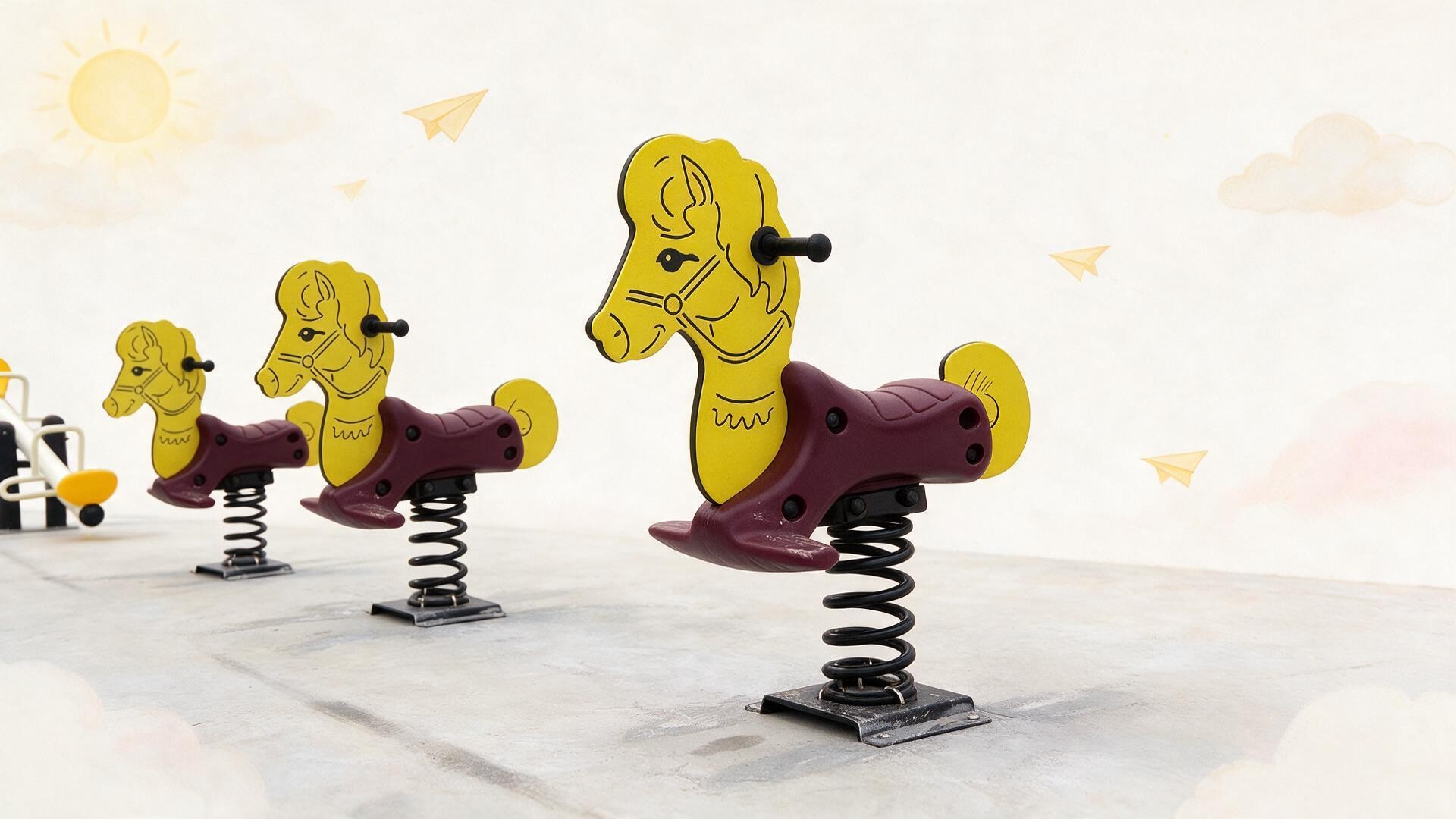
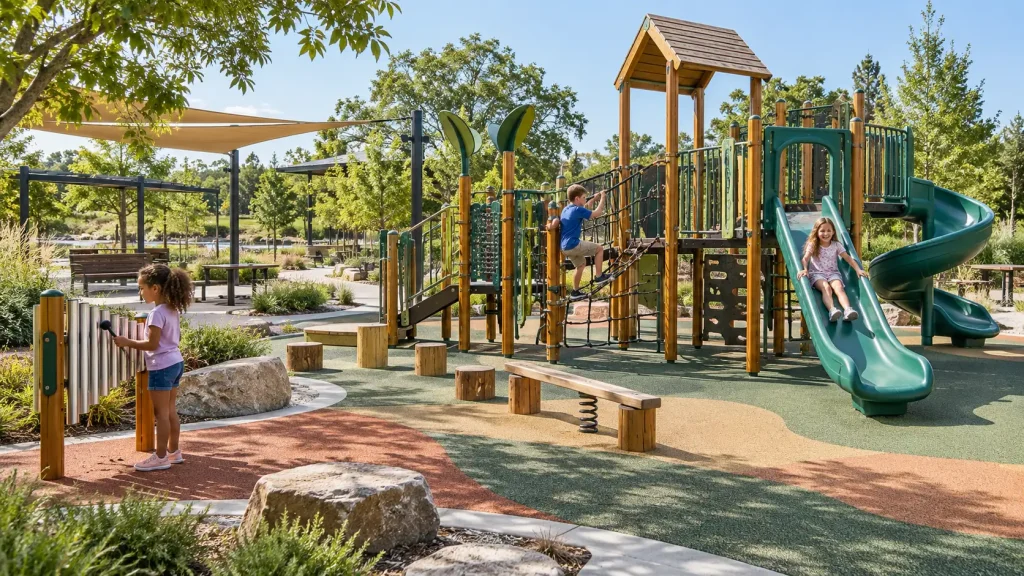
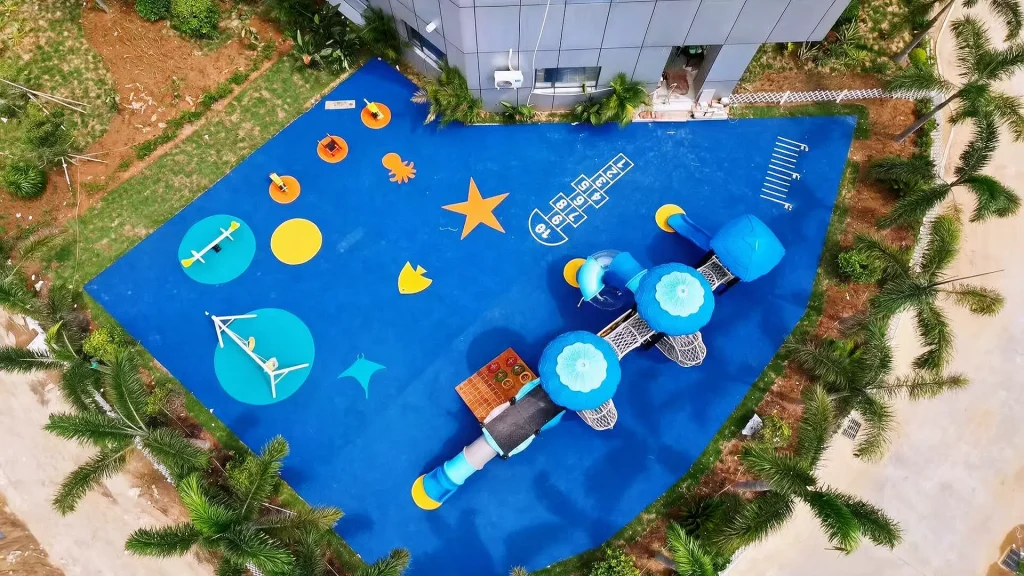
Freestanding components should be arranged as part of a coherent circulation, surfacing and supervision plan.
Safety, Accessibility and Playground Equipment Standards
Playground equipment safety standards establish technical requirements within their defined scope, but they do not replace project-specific design, local regulation, correct installation, appropriate surfacing, inspection or maintenance. Buyers should confirm both the applicable standard and the responsibilities surrounding the finished site.
United States: For public-use playground equipment, the current ASTM listing is ASTM F1487-25. Its scope covers safety and performance requirements for various public playground equipment types and dimensional requirements for clearance and use zones. ASTM states exclusions and notes that users remain responsible for determining applicable regulatory requirements.
The U.S. Consumer Product Safety Commission Public Playground Safety Handbook supports safer playground planning and use.
Europe: The EN 1176 series is relevant to public playground equipment. CEN-CENELEC identifies EN 1176-1:2017+A1:2023 for general playground safety requirements, with separate parts for equipment including swings and slides. Confirm national adoption, the applicable part and local requirements before procurement.
Accessibility Is a Layout Decision
Accessible playground planning is not achieved simply by buying one product described as accessible. Accessibility depends on the relationship between play components, accessible routes, ground space and the variety of play experiences provided across the site.
In the United States, the U.S. Access Board guidance for play areas explains accessible routes and required ground-level play components where the rules apply. Accessibility should therefore be considered when the site plan is created, not after equipment positions have already been fixed.
Procurement, Installation and Maintenance Planning
A freestanding structure is procurement-ready only when the buyer understands what is being supplied, where it will be installed, what site work it requires, what technical information supports installation and which party is responsible for inspection and long-term maintenance. Product selection without this information leaves important project risks unresolved.
Supplier Documentation Checklist
- approved layout and equipment schedule;
- product dimensions and intended age range;
- use-zone or clearance information;
- foundation and anchoring requirements;
- installation or assembly instructions;
- surfacing requirements;
- relevant testing or compliance documentation;
- bill of materials or packing information where required;
- maintenance instructions;
- warranty and replacement-parts information.
AegisPlay’s published first-party workflow states that its design and quotation stage can include 3D renderings, CAD drawings and detailed BOM pricing, followed by manufacturing, pre-shipment trial assembly and export/logistics documentation.
The useful procurement question is not simply, “Does the supplier provide documentation?”
Ask which documents will be issued, at what project stage, for which exact equipment configuration, and who must approve them before manufacturing or installation begins.
Read the project-support process:
Responsibility Matrix
| Project Stage | Buyer / Owner | Supplier | Site Contractor / Installer |
|---|---|---|---|
| Equipment selection | Approve requirements | Technical proposal | Site input |
| Layout | Review / approve | Prepare or coordinate | Verify site interface |
| Foundations | Define scope | Provide requirements | Execute if contracted |
| Equipment installation | Confirm scope | Guidance/support as contracted | Install as contracted |
| Surfacing | Approve specification | Provide equipment requirements | Install as contracted |
| Inspection | Arrange required process | Technical support | Correct installation issues |
| Handover | Receive documents | Provide agreed documents | Provide site records |
| Maintenance | Operate programme | Manuals/parts support | As separately contracted |
Contract boundary: This responsibility matrix is a planning tool, not a substitute for the contract. Every project should convert these roles into a written scope before work begins.
Installation should also be planned together with future maintenance. Bearings, moving joints, ropes, fasteners, impact areas and surfacing can have very different inspection needs. A design that is difficult to access for routine inspection may create unnecessary operational problems later.
How to Choose the Right Freestanding Play Solution
The right solution fills a defined play need, fits the complete site requirement, serves the intended users, can be installed and maintained realistically, and is supported by documentation appropriate to the project and jurisdiction. No single equipment type is automatically right for every playground.
Prepare These Five Inputs Before Requesting a Quotation
- site plan or reliable dimensions;
- target age groups;
- required play experiences;
- project location and applicable requirements;
- budget, installation scope and target programme.
Then compare proposals using the same criteria rather than comparing catalogue appearance or unit price alone.
A well-planned playground may use one large structure, many freestanding elements or a combination of both. The goal is not to maximize the number of products. It is to create a coherent sequence of play opportunities that fits the site and can be operated responsibly over its service life.
Discuss Your Freestanding Playground Project
Planning a school, community, commercial or mixed-use playground? Send AegisPlay your site information, target users, desired activities and project location to discuss suitable equipment, layout and project-support requirements.
Frequently Asked Questions
1. What are freestanding play structures?
Freestanding play structures are individual playground components that operate independently rather than being structurally integrated into a larger composite play system. Examples can include swings, slides, climbers, spring riders, spinners and musical components. They may still require foundations, defined use zones, safety surfacing and permanent installation.
2. What are the main benefits of freestanding playground equipment?
Their main advantage is flexibility. Buyers can add specific play experiences, expand an existing playground, use separated areas of a site or create a phased project. Their actual value depends on whether each component adds a useful play function while fitting the site’s space, circulation, accessibility and maintenance requirements.
3. How much space does freestanding playground equipment require?
Do not calculate space from equipment dimensions alone. The project must also account for applicable use or clearance zones, protective surfacing, movement patterns, accessible routes and normal circulation. The exact requirement depends on the selected product, installation details, applicable standards and local project requirements.
4. Which safety standards apply to freestanding playground equipment?
The answer depends on the market, equipment type and jurisdiction. ASTM F1487-25 currently addresses public playground equipment within its scope in the United States, while EN 1176 is relevant to many European public-playground projects. Buyers should confirm the applicable edition, specific standard part and local regulatory requirements.
5. Can freestanding playground equipment improve accessibility?
It can contribute to an accessible play environment, but accessibility depends on the whole layout. Routes, ground spaces and the distribution of different play experiences must be considered together. In applicable U.S. projects, Access Board requirements address accessible routes and required ground-level play components.
6. What should a supplier provide before installation?
The required package varies by contract, but buyers commonly need an approved layout, product information, installation instructions, foundation or anchoring requirements, use-zone information, surfacing requirements, relevant compliance documentation, maintenance information and agreed handover documents.
7. How should freestanding equipment be maintained?
Maintenance should follow the manufacturer’s instructions and the requirements applicable to the project. Operators should establish regular inspection and correction procedures covering structural connections, moving parts, wear points, surfacing and any product-specific components. Responsibilities should be defined before the playground opens.
AegisPlay Editorial Team
Commercial Playground Manufacturer & Project Solutions Partner