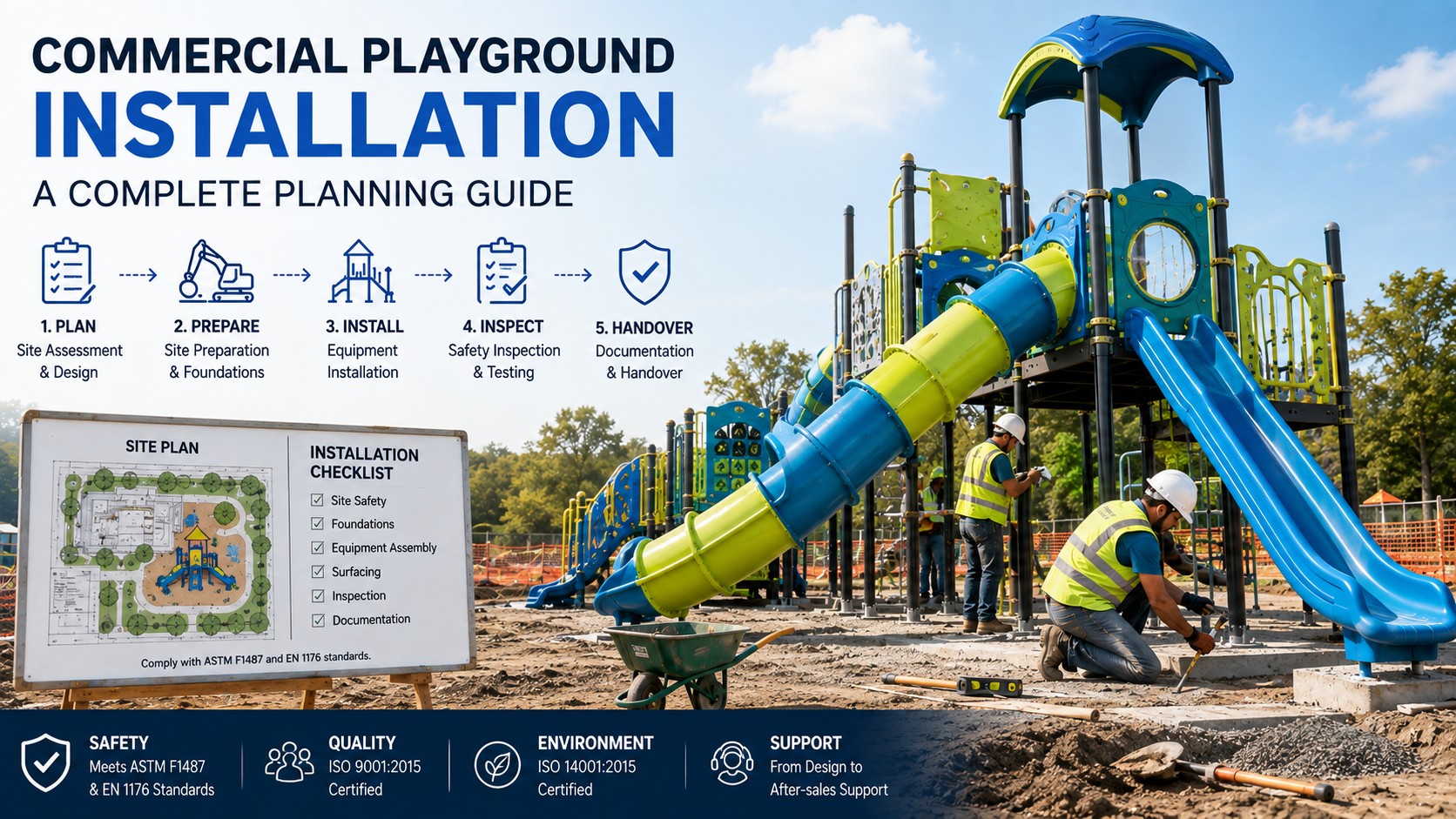
Commercial playground installation is not simply the assembly of equipment after delivery. For landscape architects, playground specialists, council planners and commercial buyers, a successful project depends on decisions made well before the installation crew arrives: site readiness, layout coordination, safety zones, foundations, applicable standards, supplier documentation, logistics, inspection and handover. This guide provides a practical framework for planning commercial playground installation from approved design through opening and long-term maintenance.
What Is Commercial Playground Installation?
Commercial playground installation is the controlled process of turning an approved playground design into an installed, inspected and maintainable play environment.
A well-coordinated project normally follows seven stages:
- Project brief and scope approval
- Site assessment and preparation
- Design, age zoning and use-zone coordination
- Supplier documentation and procurement
- Equipment delivery and installation
- Surfacing, inspection and correction
- Handover, opening and maintenance
The important point is that equipment assembly is only one stage. A playground can be physically installed and still be incomplete if the foundations, surfacing, inspection records or handover documents have not been properly addressed.
For professional buyers, the project should be considered installation-ready when the approved design, physical site and responsibility for the remaining work are aligned.
What Should Be Checked Before Commercial Playground Installation?
Before equipment is manufactured, shipped or delivered, confirm the design, site, standards, logistics and contractual responsibilities. This reduces the risk of site delays, design changes and work being duplicated by different contractors.
Commercial Playground Installation Readiness Checklist
| Checkpoint | What to confirm |
|---|---|
| Approved layout | Final equipment positions, dimensions and circulation |
| User group | Intended age range and age separation |
| Use zones | Required clearance, use and fall areas |
| Foundations | Foundation and anchoring requirements |
| Surfacing | System, performance requirements and installation scope |
| Utilities | Underground services identified before excavation |
| Drainage | Finished levels and drainage strategy |
| Site access | Delivery, lifting and equipment access |
| Storage | Secure area for delivered components |
| Supplier documents | Drawings, BOM, manuals and relevant reports |
| Inspection | Responsible person and inspection process |
| Handover | Required closeout documents before opening |
The exact checklist should be adapted to the project jurisdiction, equipment type and contract. It is especially important when equipment, foundations, surfacing and landscaping are being completed by different parties.
For projects involving excavation, underground utilities should be identified before work begins. In the United States, OSHA’s construction requirements address underground installations and require their estimated locations to be determined before an excavation is opened. Local requirements may differ, but the principle is broadly useful for site planning.
How Do You Prepare a Site for a Commercial Playground?
A commercial playground site is ready for installation when the approved layout can be set out on the actual site, access is available, underground services have been considered, foundations can be constructed as specified, and the required surfacing and drainage conditions can be achieved.
Site preparation should normally address:
- Existing equipment or structures that need removal
- Ground levels and finished grades
- Drainage and water management
- Underground utilities
- Soil and excavation conditions
- Foundation locations
- Delivery and unloading access
- Temporary storage and material protection
- Separation of construction activity from public access
The foundation plan should not be treated as an isolated drawing. Equipment positions, finished grades, surrounding paving or landscaping, safety zones and surfacing all need to remain coordinated.
Where excavation is involved, OSHA guidance also highlights soil conditions, safe access and egress, protective systems and the hazards associated with underground utilities. Its detailed requirements apply to U.S. construction workplaces; other jurisdictions should follow their own occupational-safety rules.
Who Is Responsible for Playground Installation?
There is no universal allocation of responsibilities. The contract should identify who supplies technical information, who prepares foundations, who installs equipment, who installs surfacing, who performs the final inspection and who provides the maintenance documentation.
A practical planning matrix is:
| Activity | Owner / Client | Supplier | Site Contractor |
| Final equipment selection | Approve | Design support | — |
| Design drawings | Review | Prepare | Coordinate site interface |
| Foundations | Approve scope | Technical information | Execute where contracted |
| Equipment assembly | Approve method | Install or supervise where contracted | Execute where contracted |
| Safety surfacing | Approve specification | Specify or coordinate | Install where contracted |
| Final inspection | Accept | Technical support | Site support |
| Handover | Receive | Provide documents | Provide records where applicable |
| Maintenance | Operate | Technical guidance / parts | — |
This matrix is a planning framework, not a substitute for a project contract. Actual responsibility should always be written into the scope of work.
Which Playground Standards Apply to Commercial Installation?
The applicable playground standard depends on the equipment, market and project requirements. Buyers should confirm the exact edition, scope and local regulations rather than assuming that one standard applies to every type of play equipment.
ASTM F1487-25 for U.S. Public Playground Equipment
For U.S. public playground projects, ASTM F1487-25 is the current ASTM consumer safety performance specification for public-use playground equipment within its stated scope. The standard covers various types of public playground equipment and dimensional requirements for clearance and use zones. It excludes several categories, including soft contained play equipment and public-use play equipment intended for children from 6 to 24 months.
The official ASTM F1487-25 standard page should be used when checking the current edition, scope and purchase information.
The important procurement principle is:
A standard is not automatically the same thing as a project certificate or certification claim.
A buyer should ask what product, configuration, test scope, edition and market a supplier document actually covers.
EN 1176 for European Projects
For European public playground projects, the EN 1176 series is commonly used for playground equipment and surfacing requirements. EN 1176-1 establishes general safety requirements and test methods for permanently installed public playground equipment and surfacing, with additional parts addressing specific equipment categories.
The applicable national adoption, equipment-specific requirements and local regulations should be confirmed before tender or procurement. A supplier’s reference to “EN 1176” should therefore be understood in the context of the specific product and project, rather than treated as a universal statement of compliance.
ISO 9001 and ISO 14001 Management Systems
ISO management-system standards should also be distinguished from playground product safety standards.
ISO 9001 concerns quality management systems and specifies requirements for organizations that need to consistently provide products and services meeting customer and applicable statutory or regulatory requirements.
ISO 14001 concerns environmental management systems. ISO officially published ISO 14001:2026 in April 2026, replacing the previous 2015 edition.
Where a supplier references ISO 9001 or ISO 14001, request the current certificate, scope, issuing certification body and validity date. This helps distinguish a current management-system certification from a historical or unrelated claim.
What Should a Playground Supplier Provide Before Installation?
A professional procurement package should allow the project team to understand exactly what is being supplied, how it is intended to be installed and what information is required for operation and maintenance.
Supplier Documentation Checklist
Depending on the project, ask for:
- Approved equipment layout
- Equipment schedule or BOM
- Product dimensions and specifications
- Installation and assembly instructions
- Foundation and anchoring information where applicable
- Relevant testing or certification documentation
- Surfacing requirements
- Warranty information
- Maintenance instructions
- Spare-parts information
- Packing and delivery documentation
- Final inspection or handover records
The key question is not simply whether a supplier can “provide documents.” It is whether the documents arrive early enough to support construction planning.
Aegis Play’s published Services page describes a first-party workflow that starts with requirements gathering and feasibility assessment, followed by 3D renderings, CAD drawings and detailed BOM pricing. It then describes production, 100% pre-shipment trial assembly, third-party testing through SGS/TUV, export documentation, logistics and global installation support.
That creates a useful procurement checkpoint:
What is approved before production, what is checked before shipment, and what documentation is transferred to the project team?
For buyers evaluating custom playground equipment, this sequence can be more useful than simply comparing catalogue prices.
How Long Does Commercial Playground Installation Take?
There is no single installation duration that applies to every commercial playground. Timing depends on equipment complexity, design approval, manufacturing, site preparation, logistics, surfacing, weather, inspection requirements and the division of work between the supplier and local contractors.
A more reliable approach is to plan by dependencies:
| Project stage | Primary dependency |
| Design approval | Client decisions and technical review |
| Procurement | Contract and production release |
| Manufacturing | Equipment complexity and production schedule |
| Site preparation | Civil works and foundations |
| Delivery | Manufacturing completion and logistics |
| Installation | Site readiness and crew availability |
| Surfacing | Equipment completion, substrate and weather |
| Inspection | Completion of installation and corrections |
| Opening | Owner acceptance and required approvals |
This is particularly important for projects with a fixed opening date. Instead of asking only, “How quickly can the playground be installed?”, the project team should ask:
What must be finished before installation can start, and what must be finished before the playground can open?
That distinction helps separate manufacturing lead time from actual project completion time.
What Happens After Commercial Playground Installation?
The installation phase should end with verification and handover, not simply the completion of physical assembly.
For U.S. projects, the CPSC Public Playground Safety Handbook provides official guidance covering playground design, installation, inspection and maintenance considerations. It emphasizes following manufacturer installation instructions and checking equipment before use.
The CPSC Public Playground Safety Handbook is therefore a useful reference for teams working on U.S. public playground projects.
A practical project closeout should include:
- Compare the installed equipment with the approved layout.
- Confirm assembly and anchoring against the relevant installation information.
- Verify safety surfacing and required use zones.
- Record and correct outstanding installation issues.
- Complete the required inspection or verification process.
- Receive the project handover documents.
- Establish the maintenance and inspection schedule.
What Should Be in the Playground Handover Package?
A useful handover package should answer three questions.
What was installed?
Provide the final layout, equipment schedule, product information and relevant installation records.
How should it be maintained?
Provide maintenance instructions, inspection guidance, warranty information and replacement-part details.
What evidence supports project closeout?
Provide applicable inspection records, relevant testing or certification documentation and required sign-off records.
The handover package is especially important for municipal, educational and multi-site commercial projects because responsibility may pass from the installation team to an operator who was not present during construction.
How Can Aegis Play Support the Installation Process?
For a custom commercial playground, installation quality depends on more than the final assembly crew. Design information, manufacturing controls, delivery documentation and site coordination all affect what happens on site.
Aegis Play’s published process covers requirements gathering, feasibility assessment, 3D design, CAD drawings, BOM pricing, manufacturing, pre-shipment trial assembly, third-party testing, export documentation and logistics. The company also describes guided self-installation, on-site supervised installation and turnkey installation support.
For project teams, the practical benefit of an integrated workflow is clearer communication between the approved design, manufactured equipment and installation documentation.
Aegis Play’s Services page also states that detailed installation manuals and video guides are provided, with global on-site installation supervision available for applicable projects. The exact scope should be confirmed in the project quotation and contract.
Ready to move from a playground concept to an installation-ready project? Share your site plan, project location, intended user group and preferred playground type with Aegis Play to discuss design, documentation, manufacturing and installation support. Explore Aegis Play Services.
Final Takeaway: Treat Installation as a Project, Not a Delivery Event
Commercial playground installation is successful when design, site conditions, standards, responsibilities, documentation, installation and maintenance remain connected from the beginning.
The most useful pre-installation questions are straightforward:
- Is the site genuinely ready?
- Are foundations, use zones and surfacing coordinated?
- Does the selected standard apply to this equipment and market?
- Who is responsible for each part of the installation?
- What documents will be available before delivery and at handover?
- What needs to be checked before the playground opens?
Answering those questions before equipment reaches the site can reduce avoidable delays and make the transition from approved design to operating playground much more controlled.
For commercial projects requiring custom design and coordinated manufacturing support, Aegis Play can help connect the design, production, logistics and installation stages within one project workflow. Contact Aegis Play to discuss your project requirements.
FAQ
What should be checked before commercial playground installation?
Confirm the approved layout, intended age group, use zones, foundations, surfacing, utilities, drainage, access, supplier documentation and inspection responsibilities. The contract should also identify which work belongs to the supplier and which belongs to the local contractor. A written responsibility matrix can prevent delays and scope disputes.
What standards apply to commercial playground installation?
The applicable standard depends on the equipment type, market and jurisdiction. ASTM F1487-25 is the current ASTM specification for public-use playground equipment within its stated scope in the United States. EN 1176 is commonly used for European public playground projects, subject to national adoption and local requirements.
Who is responsible for playground foundations and safety surfacing?
There is no universal allocation. Foundations and surfacing may be completed by the supplier, a local contractor or another specialist. The project contract should define who provides technical information, who performs the work, who checks completion and who accepts the finished installation.
What should a playground supplier provide before installation?
Ask for the approved layout, equipment schedule or BOM, installation instructions, foundation information where applicable, relevant testing or certification documents, surfacing requirements, warranty information, maintenance instructions and delivery documentation. Agree on the required document package before production or shipment.
How long does commercial playground installation take?
There is no universal duration. The actual schedule depends on design approval, manufacturing, site preparation, logistics, installation complexity, surfacing, weather and inspection requirements. A dependency-based project schedule is more reliable than using one generic installation timeframe.
What should happen before a playground opens?
The installed equipment should be checked against the approved design, assembly and anchoring should be verified, surfacing and use zones should be reviewed, outstanding issues should be corrected and the required inspection or verification process should be completed. The operator should then receive the handover and maintenance documentation before opening.