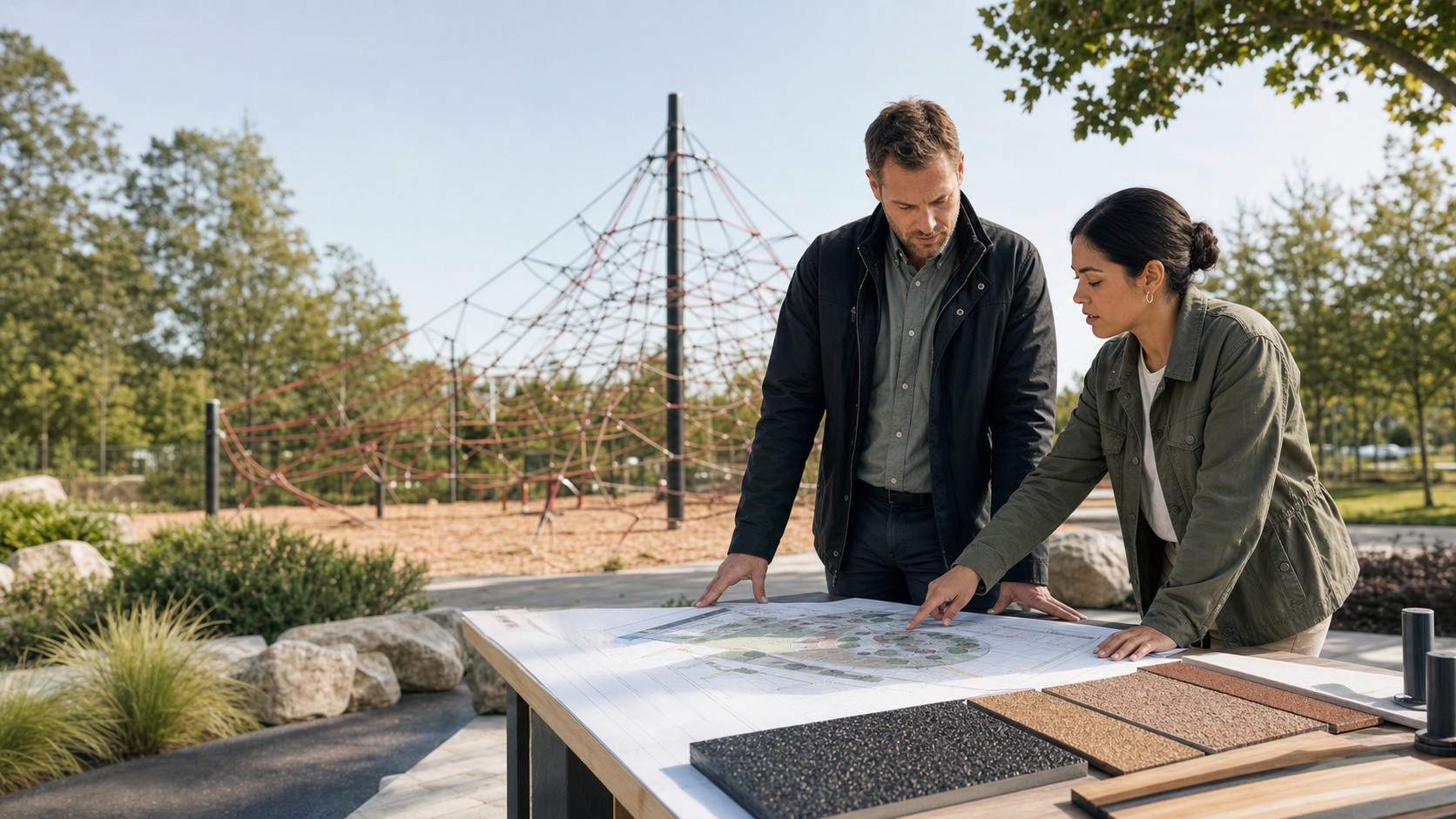
A successful rope playground project is not defined by an impressive climber alone. Landscape Architects, Playground Specialists, and Council Planners must reconcile site constraints, inclusive access, safety expectations, procurement rules, and long-term maintenance before installation begins. This playground planning guide sets out a practical route from early brief to handover, helping teams make informed decisions and produce clearer documentation.
1. Start the Rope Playground Project With a Measurable Brief
Every rope playground project should begin with a short, shared project brief. This protects the design intent when multiple stakeholders, consultants, and suppliers are involved.
Define the following before requesting concepts or quotations:
- Primary users: age bands, anticipated visitor numbers, and supervision context.
- Play outcomes: climbing, balance, social interaction, sensory activity, or destination play.
- Site role: local pocket park, school yard, civic park, waterfront, tourism destination, or mixed-use development.
- Budget boundary: include equipment, surfacing, freight, installation, drainage, access works, shade, inspection, and contingency.
- Programme: planning approvals, tender dates, construction windows, and opening date.
- Operating model: who will inspect, clean, repair, and retain maintenance records?
For playground equipment specifiers, the key is to convert broad ambitions—such as “more active play” or “an iconic feature”—into measurable requirements. For example: specify the intended age group, accessible approach route, maximum footprint, desired capacity, visual character, and required documentation.
A strong brief is also the best way to compare proposals fairly. Suppliers can propose different rope configurations, but all should respond to the same functional, spatial, safety, and lifecycle requirements.
2. Audit the Site Before the Rope Playground Project Layout
A rope structure can make efficient use of vertical space, but it still depends on careful ground-level planning. Before fixing a rope playground project layout, undertake a site audit that goes beyond a basic dimension check.
Review:
- Topography, retaining walls, slopes, and drainage direction.
- Existing trees, root protection zones, utilities, lighting, and underground services.
- Emergency and construction access.
- Sightlines from seating, paths, buildings, and supervision points.
- Sun, shade, wind, heat, and local microclimate.
- Neighbouring uses, noise sensitivity, boundaries, and traffic movement.
- Space for protective surfacing, circulation, seating, bins, bike parking, and future maintenance access.
Do not treat the rope structure’s plan footprint as the total area required. The final layout must allow for manufacturer-defined use zones, safe circulation, surfacing transitions, and separation from conflicts such as walls, paths, or fixed furniture.
For public projects, this stage should identify planning, building, accessibility, and local authority requirements early. The CPSC Public Playground Safety Handbook is useful guidance for public playground purchasers, installers, designers, and operators; however, project teams must still confirm the rules that apply in their jurisdiction.
3. Shape the Rope Playground Project Around Real Play Scenarios
A good rope playground project should offer more than a single climbing challenge. Consider how children arrive, choose activities, rest, observe others, and move between play zones.
Scenario 1: Neighbourhood park renewal
For a community park, a medium-height rope net can become a visible focal point while lower-level play elements support younger users and carers. Position seating and shade so supervision is practical without interrupting play circulation.
Scenario 2: School or education campus
For schools, durable equipment, predictable circulation, and manageable supervision are central. A rope trail can support balance and movement between zones, while a larger net climber can serve as a structured challenge area for older children.
Scenario 3: Destination park or civic waterfront
For a destination setting, the rope playground project may use a taller climber, integrated landscape forms, and distinct play zones to create a memorable identity. At this scale, crowd flow, accessible arrival, queuing pressure, and maintenance access require as much attention as the structure itself.
When selecting components, build a balanced play mix:
- Climbing: nets, rope pyramids, towers, and traversing elements.
- Balance and movement: rope bridges, stepping routes, and low trails.
- Ground-level participation: sensory, social, imaginative, or manipulative play.
- Rest and recovery: seating, shaded edges, and lower-intensity play opportunities.
- Inclusive engagement: activities that do not require every user to climb to participate.
Explore relevant commercial playground equipment options and playground systems only after the brief and site constraints are clear.
4. Write a Rope Playground Project Specification, Not Just a Product List
For playground equipment specifiers, a robust specification is one of the most valuable project controls. It should describe the intended performance, documentation, installation expectations, and acceptance criteria—not merely list a product name.
In the United States, ASTM F1487 addresses public playground equipment safety and performance, including clearance and use-zone requirements. Consult the current ASTM F1487-25 standard and project-specific local requirements when preparing documentation. In European markets, EN 1176 is the principal reference series for permanently installed public playground equipment and surfacing.
Use objective language such as:
“Provide rope play equipment designed and installed in accordance with the applicable edition of ASTM F1487 or EN 1176, together with manufacturer installation, inspection, and maintenance documentation.”
Avoid writing “compliant” unless the supplier can provide evidence that directly applies to the specified configuration, site, installation method, and jurisdiction.
| Specification control | Include in tender or submittal | Why it matters |
|---|---|---|
| Product data | Dimensions, age range, capacity, materials, colour options | Enables like-for-like review |
| Layout information | Footprint, use zones, fall heights, surfacing extents | Prevents site and coordination conflicts |
| Structural information | Anchoring, foundations, loading assumptions, installation method | Supports engineering and construction coordination |
| Safety evidence | Applicable ASTM F1487 or EN 1176 documentation | Supports compliance review |
| Material information | Rope construction, connectors, steelwork finish, UV and corrosion considerations | Informs durability decisions |
| Handover documents | Inspection, maintenance, parts, and warranty information | Supports the operator after opening |
Mid-article CTA: If your team needs help turning a concept into coordinated specifications, use Aegis Play’s design and project support services to discuss layouts, technical information, and procurement documentation.
5. Design Inclusion Into the Rope Playground Project From Day One
Inclusion is not achieved by adding one accessible item after the layout has been completed. It should influence the arrival route, surfacing, play variety, rest areas, and communication throughout the rope playground project.
For U.S. public facilities, the ADA guidance identifies play-area scoping and technical requirements, including accessible routes and play components. Review the ADA play-area guidance alongside local requirements.
Practical design actions include:
- Provide an accessible route from parking, drop-off, or the park path to the play area.
- Coordinate impact attenuation with accessible surfacing requirements where applicable.
- Distribute ground-level experiences instead of isolating them at the edge.
- Include social, sensory, and imaginative activities alongside physical challenge.
- Provide companion seating, shade, and clear resting points.
- Use clear wayfinding and avoid forcing carers to cross active fall zones.
A rope climber can remain a central attraction while the wider playground offers several ways to participate. This gives councils and design teams a stronger basis for demonstrating inclusive public value.
6. Budget the Rope Playground Project for Whole-of-Life Value
A low equipment price does not automatically represent the lower project cost. A well-managed rope playground project budget separates visible procurement costs from site and lifecycle costs.
Include allowances for:
- Site survey, design coordination, permits, and approvals.
- Demolition, utility location, excavation, drainage, and base preparation.
- Equipment, freight, unloading, installation, and protective surfacing.
- Shade, fencing, paths, seating, planting, and signage.
- Independent inspection or commissioning where required.
- Spare parts, planned maintenance, and future rope or connector replacement.
Ask suppliers to state exclusions clearly. This prevents surfacing, foundations, civil works, or access upgrades from appearing late in the programme as unplanned variations.
For a procurement process, request a comparable cost schedule that separates equipment from installation and site works. It is also sensible to ask for lead times, payment milestones, warranty scope, and maintenance responsibilities in writing.
7. Coordinate Delivery, Installation, and Inspection
A rope structure is a system of interconnected components, foundations, tensioned elements, and surfacing. The rope playground project should therefore include a coordination meeting before construction begins.
Confirm:
- Approved layout, levels, use-zone boundaries, and surfacing extents.
- Foundation locations and interface with drainage or underground services.
- Delivery route, lifting requirements, equipment storage, and site security.
- Installation sequence and any temporary exclusion zones.
- Manufacturer installation instructions and required inspection points.
- Final inspection, defect resolution, and operator handover process.
Do not open the play area simply because the equipment looks complete. Handover should occur after the project team has received the agreed documents, completed applicable inspections, and confirmed that surfacing, access, signage, and surrounding works are ready for use.
8. Close the Rope Playground Project With a Maintainable Handover
The best time to plan maintenance is before the equipment is purchased. Ask for a clear operation and maintenance package covering routine visual checks, operational inspections, annual inspections, wear components, rope condition, connector checks, cleaning, and replacement procedures.
Where suppliers reference management systems such as ISO 9001:2015, request the current certificate, certification scope, issuing body, and validity dates. ISO 9001 is a quality-management framework; it is not, by itself, evidence that a specific playground installation meets the applicable safety standard.
Use Aegis Play case studies to review relevant project approaches, then assess each example against your own site, users, climate, regulatory environment, and maintenance resources.
A carefully planned rope playground project gives landscape teams and public authorities more than an eye-catching play feature. It creates a documented pathway from community need to safe delivery, inclusive use, and manageable long-term operation.
Ready to move from an early idea to a coordinated rope playground project? Contact Aegis Play to discuss your brief, site information, preferred play outcomes, and specification requirements before tender or detailed design begins.
FAQ
Q1: What information should be included in a rope playground project brief?
A: Include user ages, intended play outcomes, site dimensions, budget range, programme, accessibility requirements, preferred visual direction, and the party responsible for long-term maintenance.
Q2: Which safety standard applies to rope playground equipment?
A: This depends on the market and authority having jurisdiction. ASTM F1487 is commonly used for U.S. public playground equipment, while EN 1176 is widely used in Europe. Confirm local legal and procurement requirements before specifying.
Q3: Can rope playground equipment be customised?
A: Often, yes. Discuss configuration, colour, layout, site interfaces, and documentation requirements through Aegis Play’s project support services.
Q4: How should I plan surfacing around a rope climber?
A: Use the manufacturer’s fall-height and use-zone information, then coordinate the selected surfacing system with applicable safety, accessibility, drainage, and maintenance requirements.
Q5: What should Council Planners request at handover?
A: Request final drawings, installation records, safety documentation, inspection reports where required, maintenance instructions, warranties, spare-parts information, and emergency contact details.
Q6: How early should a playground equipment supplier be involved?
A: Engage a supplier after the initial brief and site information are available, ideally before the layout and tender documents are fixed. This helps identify space, foundation, surfacing, and lead-time issues early.